

/ News, Studium, Doktorat, Events, People, Info
“What is Critical about Programming?”, 7th Symposium on the History and Philosophy of Programming
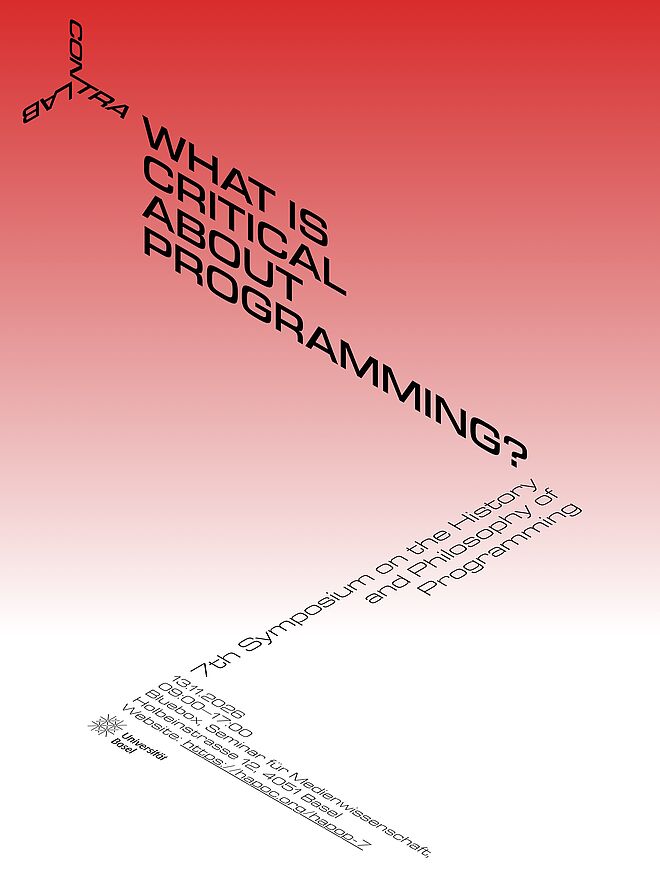
A day-long symposium around the notion of criticality in programming systems, languages and practices.
09:00–17:00 November 13, 2026
Bluebox, Seminar für Medienwissenschaft, Holbeinstrasse 12, 4051 Basel
In the spirit of interdisciplinary inquiry into programming, this symposium will focus on “criticality in programming”, asking broadly “what is critical about programming?”. Recalling the shared etymological root of “critical” with “crisis”, we start from appreciating a critical moment, a crisis, as that which requires a decision, and thus sharp, unambiguous judgment, to dismiss any doubt. A crisis requires a critical assessment of a situation, and subsequent action, considering programming as both a reflexive and decisive action.
The initial crisis of programming, the so-called “software crisis” of the 1960s, was addressed through the hardening of practices (Dijkstra 2007). Critically assessing the state of programming practices resolved a crisis by changing how programming is done. How was the engineering crisis conceived in the first place? What kinds of soft uncertainties were taken out to solve it? What methodologies (e.g. code reviews, proofs, tests, perpetual beta) and arrangements (e.g. specialisation and professionalisation) compose this hardening, and how were judgments passed as to whether the software engineering crisis had been averted? More recently, tooling based on large language models might constitute a new critical moment. How should it be assessed when employed in building critical systems? What kind of crisis might it represent to existing conceptions and histories of programming?
The event is part of the History and Philosophy of Computing commission and is organized by Pierre Depaz (DHLab), Yannick Nepomuk Fritz (Medienwissenschaft) and Mace Ojala (Ruhr-Universität Bochum). Attendance is free and in person only; please register by writing to basel-2026@clutterhapoc.org.
More information and full program: hapoc.org/hapop-7/
Quick Links
Social Media